


December 2005. You’re at an early performance of the new musical The Color Purple produced by, among others, Oprah Winfrey (who was Oscar nominated for her work in the film version). The score—by three legendary pop-writers who had never really collaborated together or written a musical before—blends jazz, blues, ragtime, folk, and contemporary music. The musical opens with an overture (when’s the last time you heard a new musical do that?) before introducing Celie, a young woman, pregnant for the second time with her father’s child, playing a clapping game with her sister Nettie. With the aid of a recurring trio of church ladies to help with exposition, we follow Celie from age 14 to 60, all played by one actress, LaChanze. After being forced to give up both of her father’s children, she’s married off to an abusive widower, Mister, who isolates Celie and prevents Nettie from contacting her. Celie finds strength in her relationships with two women. Sofia, married to Mister’s son from his previous marriage, inspires Celie with her independence and sense of self-worth, refusing to tolerate abuse from anyone, even when it means a jail sentence. (This is the role Oprah played in the movie). Shug Avery is a jazz singer and longtime mistress to Mister. When Shug becomes ill, and Celie nurses her back to health, Shug responds love and support, calling Celie “too beautiful for words.” Celie eventually leaves Mister to live with Shug and opens a successful tailoring business. When Shug leaves Celie for one last fling with a young musician in her band, Celie looks back on her life and realizes that, despite the loss and pain, she’s had a life full of love and, for the first time, genuinely directs that love towards herself. (“I’m Here”)
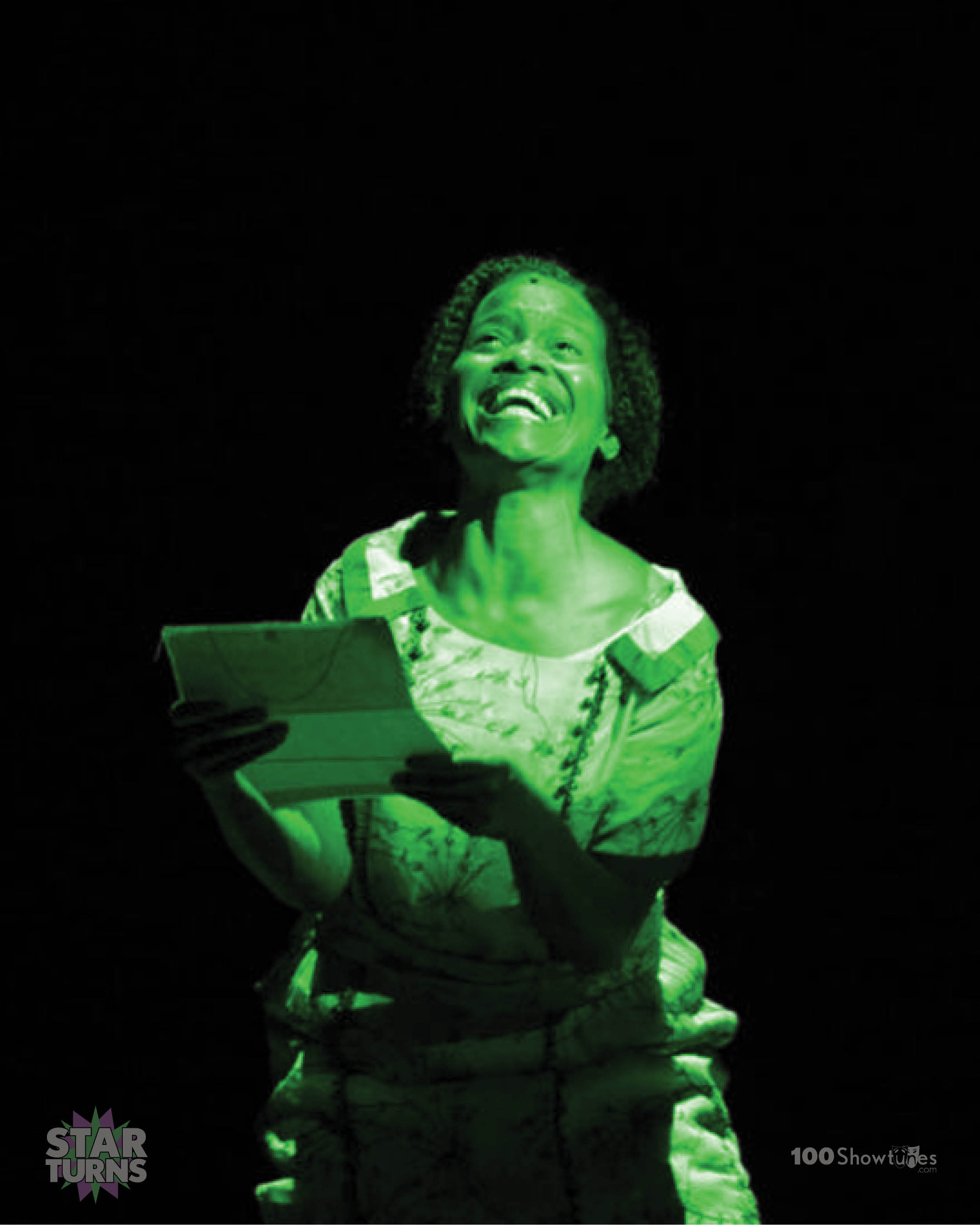
Celie is an interesting sort of star turn. Any piece that asks an actor to play a character that ages 36 years becomes a showpiece for that actor. But Celie is also quiet, even sullen, until she’s slowly brought out of her shell by Sofia and Shug. For a character that is onstage for 90% of the performance, she’s doesn’t sing all that much, with only one solo before the climactic “I’m Here.” The roles of Shug and Sofia also became star-turns. These unapologetic and opinionated women are more traditional centers of a musical, and suppy the brassy confident numbers the show needs but Celie can’t provide. As she finds strength in these relationships, she also finds her star power.
“I’m Here” is Celie’s musical showcase, and the song reflects her growth over the course of the show. It begins with a monumental observation: “I don’t need you to love me. / I don’t need you to love.” She is most directly referring to Shug’s departure, but “you” just as easily applies to everyone in Celie’s orbit as she realizes she doesn’t need anyone else’s expectations or permission to live life on her terms. The song starts out tentatively, as Celie reflects on the past and all the good things she has in her life. As she starts to sing of how she will move through the world more confidently in the future, the music and performance have more drive and power. Finally, the song moves into its brashest, beltiest section as Celie asserts in the present, “I believe I have inside of me / Everything that I need to live a bountiful life.” The song evolves along with Celie’s awakening, with each section bringing a new musical idea that reaches a glorious pinnacle when she can confidently say “I am here.”
Recommended Recording: ”I’m Here” The Color Purple (2015 Broadway Revival Cast)
A Broadway revival arriving less than 10 years after the original production closed may have sounded pre-mature on paper, but the production, first directed in London by John Doyle, felt like an entirely new show. Doyle is known for pensive, minimalistic productions, starting with his actor-musician Sweeney Todd (which, coincidentally, opened the same season as The Color Purple’s first run). His revival of Purple cut about 30 minutes of material, introduced folkier orchestrations, and focused on the depth of performances and relationships onstage—particularly those between Celie, Sofia, and Shug. The focus and clarity of vision revealed a book and score that were a lot stronger than people remembered. The production cast two American stars as Sofia and Shug—Danielle Brooks and Jennifer Hudson—and brought over the London Celie, Cynthia Erivo in her Broadway debut. Even in a season dominated by Hamilton-mania, Erivo caused a sensation. Movie roles followed, and next thing we knew she was Elphaba!
Alternate Performances
The Color Purple has received three cast recordings.
2005 Original Broadway Cast - A beloved veteran with more Broadway experience than the entire creative team, LaChanze finally had with Celie the chance to headline a Broadway musical in a role that showcased her full range. A pre-Hamilton Renée Elise Goldsberry plays Nettie. It’s a solid recording, though it has a tendancy to flatten the narrative into what feels like a montage. (Especially once you’ve heard the more nuanced revival recording).
2023 Film Soundtrack - Producer Scott Sanders optioned the musical rights for The Color Purple from Alice Walker in 1999, then spent 5 years building a creative team before its Broadway premier. He then produced the London revival and its Broadway transfer and, ultimately, the movie version. (Oprah joined the producing team as the biggest name on the Broadway 1.0 marquee and stayed on through its subsequent iterations including this film.) I would have thought that, after the revival’s success, they would have carried those lessons learned into the film. But instead they just decided to try a whole other thing. Fantasia Barino plays Celie after triumphing in the role as the final Broadway 1.0 replacement and its national tour. Blitz Bazawule (co-director of Beyoncé’s Black is King) directs with a screenplay by Marcus Gardley that cuts a lot the original score and introduces a handful of forgettable new numbers. The most bewildering cut is at the beginning of “I’m Here,” where they omit the opening lines, which are arguably the most important lines in the entire show! (They do appear on the soundtrack recording…so someone knew what was up.) Bazawule explained the choice, saying, “Being slighted (by a lover) is a good place to start a moment like that, but I felt it needed a deeper meaning to Celie.” But that’s not what the lines are about?!? It’s truly just a small handful of lines, but it makes me question if they really understood the material at all. That being said, it’s a decent movie, even if it seems a weird place to end up after 24 years of development. It’s visually interesting and well paced. Fantasia is particularly great, and other highlights include Danielle Brooks, recreating her Sofia from the revival, and Coleman Domingo as Mister.
Is it Covered by The Rat Pack, Audra McDonald, or Glee?
No.
In the Wings
Would you look at that? We’re halfway through the list! It’s taken a lot longer than I expected to get here, but I also can’t believe we’ve reached this point already! (I’m a Gemini, I contain multitudes.) I think the cadence of sending out a new song every 3rd Wednesday is the most sustainable path forward, so No. 51 should drop around September 30. Until then, I would look up Brenda Russell, Allee Willis and Stephen Bray, each of whom has (co-)written at least one song you’ve heard a thousand times. Also check out this Emmy-winning performance of the title song from The Today Show.
Catch up with all the songs to date!
Voiceover RSS feed for podcast apps: https://api.substack.com/feed/podcast/4189121.rss