


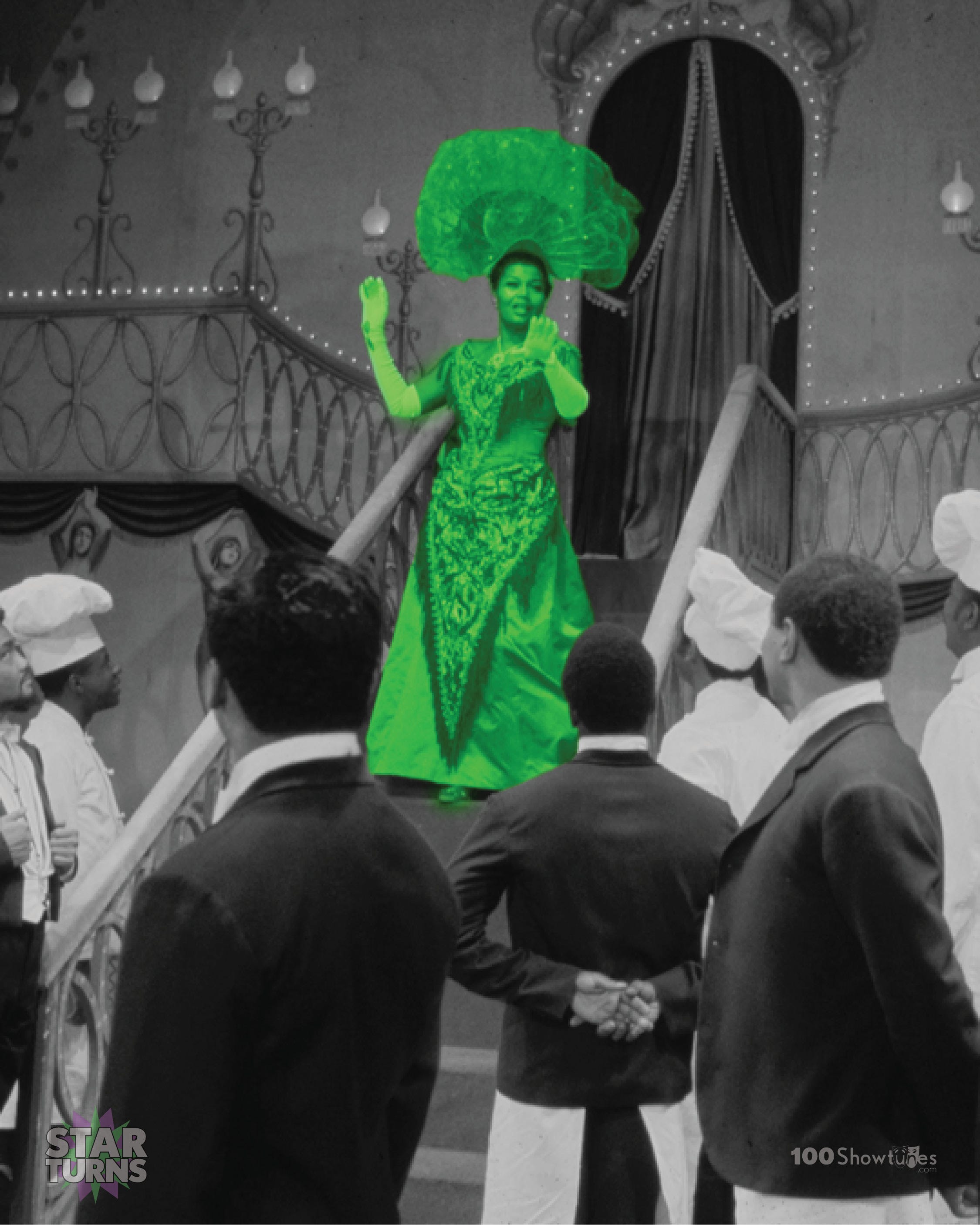
Winter 1964. You’re seeing the new smash hit musical Hello, Dolly!. The production skips the overture and opens immediately on a chorus on 1880s New Yorkers instructing the audience to call on the local matchmaker before Carol Channing revealing herself as Dolly from behind a newspaper. The briskly paced farce centers on this singular creation, a widow who makes ends meet as a matchmaker (but also has a business card in her pocket offering her services for any occasion that may come up, no matter how niche or bizarre.) Quick-witted and resourceful, Dolly takes her assignment (finding a bride for Horace Vandergelder, an irracable Yonkers shop-owner), and completely subverts it, setting up machinations that will land Horace for herself while leading to love for two of his clerks and a pair of milliners. Channing is so endearing as Dolly that you are completely on her side for all of these schemes, which are set converge at The Harmonia Gardens, a restaurant Dolly frequented with her late husband. The head waiter hears that Dolly will be in attendance and instructs the waitstaff to speed up service, launching a dazzling comedic display of leaps and gags. But all comes to a standstill when Dolly arrives standing atop a grand staircase in a stunning red gown beginning the most spectacular production number you’ve ever seen. (“Hello, Dolly”)
Dolly Levi is a musical comedy dream of a character that practically willed herself into existence…and it only took 130 years. The source material, Thornton Wilder’s 1954 play The Matchmaker, was a revision of his 1938 play (The Merchant of Yonkers), which was in turn based on an 1842 Austrian adaptation of an 1835 British one-act. For The Merchant of Yonkers, Wilder created a minor character not seen in previous versions—Dolly, a matchmaker for the titular shopkeeper. That play flopped, but audiences responded well to Dolly. So when Wilder had the chance to take another pass at Merchant, he made her the center. David Merrick produced The Matchmaker on Broadway, saw more potential in the material, and acquired the musical rights. He got his first choice in librettist, Michael Stewart, but hit a snag when his first choice composer, Bob Merrill, declined. A relatively unknown composer, Jerry Herman, won the assignment after writing four demo songs, including “Hello, Dolly!” Merrick first approached Hal Prince about directing, but Prince—who had directed a successful off-Broadway Matchmaker—didn’t want to retread familiar ground. Besides, he thought the song “Hello, Dolly” didn’t make dramatic sense and wanted to cut it1.
The gig went to Gower Champion, who sensed this was the stuff of musical theater legend. He spent the first two weeks of the initial five week rehearsal period staging “Hello, Dolly!” and its rapid-service lead-in, building the number until it had Dolly leading a parade of waiters into the audience on a passerelle around the orchestra before the waiters leapt over the pit. Once it was set, Champion said, “now I’ve got the level of the show,” meaning he knew the scale, tone, and degree of spectacle they were going for and could stage the rest of the production to reach those heights.
But who could play the woman that lives up to this much hype? Their first choice was Ethel Merman, and Herman started writing the score for her voice. But Merman said no, as did Mary Martin. Carol Channing ended up being everything they didn’t know they needed. Her madcap but precise comic style led to a woman full of surprises who always seemed one step ahead of everyone else. She could reduce an audience to tears of laughter—like when she ate a full chicken dinner as a police raid and trial happened around her—or move them to tears of compassion during her frequent tender addresses to her late husband, Ephram. Channing made the musical Dolly “real,” but the character would continue to live on after her with a string of starry replacements, basically inventing the casting process behind long-running musicals we have today. Merman and Martin even took on the role they first turned down, with Merman closing the Broadway company and Martin opening the London production and touring it internationally.
Recommended Recording: “Hello, Dolly!” Hello, Dolly!(1967 New Broadway Cast)
Pearl Bailey led an all-black replacement cast on Broadway (and on tour). She was already a notable star, and Dolly became a signature role for her, leading to the unprecedented decision to release a replacement cast recording. I love her rendition of the title song, especially all the “hellos” she adds as the waiters sing the refrain. The whole album is a great listening experience, especially if you want that Golden Age energy but just aren’t in the mood for Carol Channing. It’s not readily available on streaming platforms, but is available for purchase digitally.
Alternate Performances
Hello, Dolly! has received ~31 cast recordings, including Argentinian, Berlin, Brazilian, Czech, Danish, French, German, Hungarian, Israeli, Italian, London, Mexican, Munich, Netherlands, Paris, Russian, and Vienna casts. When the production was just beginning its troubled out-of-town tryouts, Louis Armstrong had one of the biggest hits of his career with “Hello, Dolly!,” inspiring the creative team to make that the show’s title instead of Dolly, A Damned Exasperating Woman. (It also led to Jerry Herman winning the Grammy for Song of the Year.) In 1969 Carol Channing and Pearl Bailey led a joint TV special in which they both performed Dolly numbers as well as individual special material.
Original 1964 Broadway Cast - The Original Broadway Cast recording is one of the all time classic great cast albums with Channing at the peak of her powers. It was certified Gold within months of its release. Channing continued playing Dolly for decades, culminating in a 1994 tour and Broadway revival, which received its own cast recording. I wouldn’t go so far as to claim you can’t detect 30 years of wear and tear on her performance, but it’s an exciting recording with full, lush orchestrations.
1969 Film Soundtrack - By all accounts, Hello, Dolly! was an unpleasant movie to make. Barbra Streisand was far too young and had no chemistry with co-star Walter Matthau on or off camera. Director Gene Kelly didn’t have a clear vision of how to make the material work on screen, and choreographer Michael Kidd settled for a “more is more” approach. But it’s sumptuously produced, Streisand sounds great and tries to make the most of the situation, and the movie often works in spite of itself. Pixar did a major solid to its legacy when it featured clips prominently in Wall-E to tremendous emotional effect.
2017 Broadway Cast - Bette Midler became the first non-Carol Channing to open a production of Hello, Dolly! on Broadway, making it the hottest show in town 53 years after it’s original debut. Bernadette Peters took over after Midler left (with the New York Times proclaiming she entered for the title number “as if she invented stairs”). But producer Scott Rudin never managed to come up with another replacement, and it closed after Midler made a short return engagement2.
Is it Covered by The Rat Pack, Audra McDonald, or Glee?
The Rat Pack - Frank Sinatra recorded “Hello, Dolly!” in 1964, and Sammy Davis Jr. recorded it in 1965. The Dean Martin Show featured a few Dolly songs during its run.
Audra McDonald was rumored as a replacement Dolly during the 2017 revival (and should absolutely play the role someday, but not for Scott Rudin, the guy who sued her for getting pregnant). While she has not recorded the title song, she sings “Before the Parade Passes By” in concert, including the London Palladium concert that aired on PBS.
In the Wings
As you wait for song no. 45 to drop, you may want to check out Before the Parade Passes By: Gower Champion and the Glorious American Musical by John Anthony Gilvey, which has a great breakdown of Dolly’s creative process and evolution from surefire flop in Detroit to one of Broadway’s all time great successes.
Catch up with all the songs to date!
Voiceover RSS feed for podcast apps: https://api.substack.com/feed/podcast/4189121.rss
He wasn’t necessarily wrong, but the thing about musicals is sometimes things don’t make sense but work anyways. Much like how one can enjoy Apple Jacks cereal even though it doesn’t taste like apples.
Despite all the well-documented and justified reasons people dislike Rudin, he still gets credit for being a good—even NECESSARY—producer despite never once having a plan for what to do with a show after awards season is done.