Fall 1983. You’re at La Cage Aux Folles, a new musical with a score by Jerry Herman—who wrote some of the biggest hits of the 1960s but hasn’t been so lucky lately—and a book by Harvey Fierstein. Fierstein made his Broadway debut a year prior, writing and starring in the smash hit play Torch Song Trilogy, which mad him one of the most visible and open gay celebrities in America. The musical opens on a line of chorines leading an opening number about gender ambiguity at a drag club in St. Tropez, “We Are What We Are.” Georges, the club’s owner and emcee, lives with his flamboyant husband Albin, who performs as Zaza, the club’s leading act. The couple’s adult son, Jean-Michel makes a surprise visit to announce that he is engaged, and his financé’s parents (the Dindons) want to meet his family. There’s just one little problem—Papa Dindon is a conservative “return to family values” politician whose primary political objective is shutting down drag clubs1, and Jean-Michel has been concealing his parents’ relationship and careers. Georges and Jean-Michel butch up the apartment behind Albin’s back and make a plan to hide Albin while bringing in Jean-Michel’s birth mother to meet the Dindons. After discovering this plot, Albin takes the club’s stage in full Zaza regalia, dismisses the other dancers, and sings a powerful, anthemic version of the opening number, “I Am What I Am.”
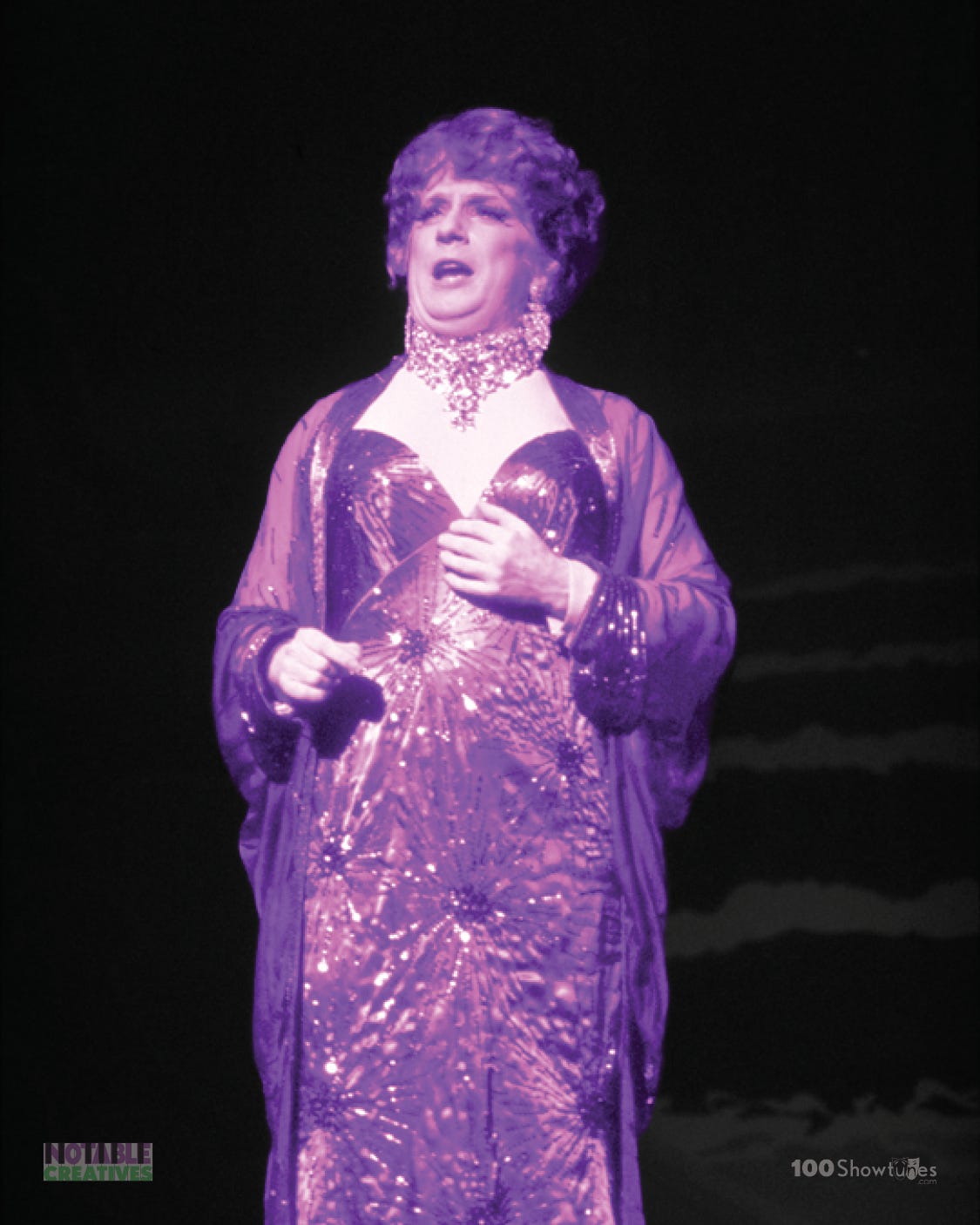
La Cage Aux Folles was almost a musical called The Queen of Basin Street with a New Orleans setting, a book by Jay Preston Allen, a score by Maury Yeston, choreography by Tommy Tune, and direction by Mike Nichols. New producers came on board and insisted on a new creative team, bringing in Harvey Fierstein, the hottest playwright in town, and Jerry Herman. (Nichols went on to direct a different Americanized adaptation for film—The Birdcage.) Herman and Fierstein must have seemed like an odd pairing at first—Fierstein defied the odds when his edgy downtown play became a long-running Broadway hit, while Herman was wholesome, possibly even old-fashioned, and hadn’t had major success in over a decade. (A revival of his last hit, Mame, was bombing spectacularly on Broadway when La Cage… opened.) But the partnership resulted in a musical that was both unabashedly queer and a good old-fashioned American crowd-pleaser. The act one closer, “I Am What I Am,” still resonates deeply today and has basically become the Gay National Anthem. Herman’s biggest hits were about larger-than-life personalities who defy convention and help others lead more authentic lives—so perhaps he had been writing about drag queens the whole time.
Recommended Recording: ”I Am What I Am,” La Cage Aux Folles (1985 Australian Cast)
Australian actor Jon Ewing delivers a powerful rendition of “I Am What I Am.” The orchestra is straight up fire—I don’t know what they did, but it’s somehow more epic than any other rendition I’ve heard.
Alternate Performances
La Cage… has received ~12 cast recordings, including Berlin, Italian, Columbian, Mexican, and Japanese casts (but not French). New York City Encores! has added it to their 2026 season, featuring Billy Porter, Wayne Brady, and an all-Black cast.
1983 Original Broadway Cast - George Hearn starred as Albin. He was most know for stern, authoritative stuff without a hint of camp on him (unless you count dating Dixie Carter for a few years). But he sounds like he’s having a blast on the upbeat numbers, and his gravitas and rich baritone anchors a thrilling rendition of “I Am What I Am.” Powers that be still thought a man in drag was too much for the Tony telecast, so Hearn sang “I Am…” in a tux with no wig or makeup.
Gloria Gaynor recorded a disco version of “I Am What I Am” shortly after the show opened, and it became an international hit. Based on her current politics, it doesn’t seem like she ever really listened to the words.
2010 Broadway Cast - This production of La Cage… came over from London. On paper it seemed completely unnecessary—La Cage…had just been revived on Broadway in 2005–but in that short time, our perception and relationship to drag changed significantly, in no small part due to RuPaul’s Drag Race, which began in 2009. The production reflected a sleeker, sexier approach to drag than the more camp aesthetic of the 80s. Douglas Hodge came over from London, reprising his precise and hilarious Albin. (Kelsey Grammer played Georges and, like Gloria Gaynor, apparently managed not to internalize anything he heard, said, or sang in that production.) Harvey Fierstein took over the role of Albin for the last few months of the run. Jeffrey Tambor was supposed to play Georges at that time, but he struggled and was gone within two weeks.
Is it Covered by The Rat Pack, Audra McDonald, or Glee?
The Rat Pack - Sammy Davis Jr. keeps giving me reasons to like him. He sang “I Am What I Am” on a television special, prefecing it by telling everyone to walk-not-run to see La Cage…. What a guy!
Audra McDonald has been singing “I Am What I Am” for several years. It opens her 2018 album Sing Happyand her 2024 special Audra McDonald at the London Palladium.
Glee has somehow not performed “I Am What I Am.” Make it make sense.
In the Wings
You may have noticed a “Listen to this post” widget on top of this page and wondered what that was about. I’ve sneakily started recording voiceovers of me reading the posts. I had been reading them aloud to myself to help with editing, and figured I might as well press record. (Turns out, it’s a lot harder than that, and voice over actors deserve a lot of credit.) I might get out No. 34 before the end of the year, or I might blink and wake up in January. Until then, I recommend the documentary, Words and Music by Jerry Herman which is available on youtubeand does a wonderful job of putting his career in context. And I know I said way back during my ground rulesthat I wouldn’t allow myself to discuss the Tony Awards, or I’d never stop, but the 1984 showdown between La Cage… and Sondheim’s Sunday in the Park with George is legendary, especially Herman’s acceptance speech, which many felt was an explicit rebuke of Sondheim. There’s like 40 years of discussion you can read up on if you’re so inclined.
Pardon my French, but why the FUCK is this 1978 French plot device so relevant in 2025 America?