


It’s 1998, and you’re one of the lucky few to catch Parade during its short run at Lincoln Center Theater. You’ve heard good things about the score by a talented young composer, Jason Robert Brown, but you’re a bit apprehensive about the show’s subject matter. You’re settling in for an evening that will explore a rape and murder in Atlanta, the trial of the falsely accused Leo Frank, and the anti-semitism-fueled lynching after Frank’s death sentence is commuted to life in prison. “So why is it called Parade?,” you ask as you flip through the Playbill before it starts. That question is soon answered. The lights come up on a Confederate soldier singing to his unseen sweetheart before he leaves to fight in the Civil War. As he leaves, the scene transforms into a Confederate Memorial Day parade fifty years later (1913). The soldier, now an old man, again sings with pride about the community he fought to protect as the chorus sings along and Confederate flags wave (“The Old Red Hills of Home”). It’s a glorious rousing song, which makes its sentiment all the more chilling. This is the Atlanta Leo Frank, a New York Jew, lives in, and he will learn first hand the lengths to which they will go in order to preserve their delusions of pre-Reformation glory.
Parade has enough similarities with Ragtime that I have been hesitant to put them next to each other on this list. They’re both (1) historical dramas exploring tensions between Jewish, affluent white, and Black communities (2) set in the first decades of the 20th century that (3) feature lush scores for large ensembles and (4) were produced by Livent. (The Hal Prince revival of Show Boat is the third infinity stone in the Livent Theatrical Universe of turn-of-the-Century musical dramas). Livent boasted an innovative approach to producing as the first publicly traded theatrical production company. They mounted huge artistically successful award-winning productions and seemed to reap fiscal rewards to match. Unfortunately, their cheery financial outcomes were, in fact “accounting irregularities” (i.e fraud). This creative bookkeeping came to light during Parade’s run, leaving co-producer Lincoln Center with the bill and making Livent founder Garth Darbrinski the first person to serve a lengthy prison sentence for musical theater1.
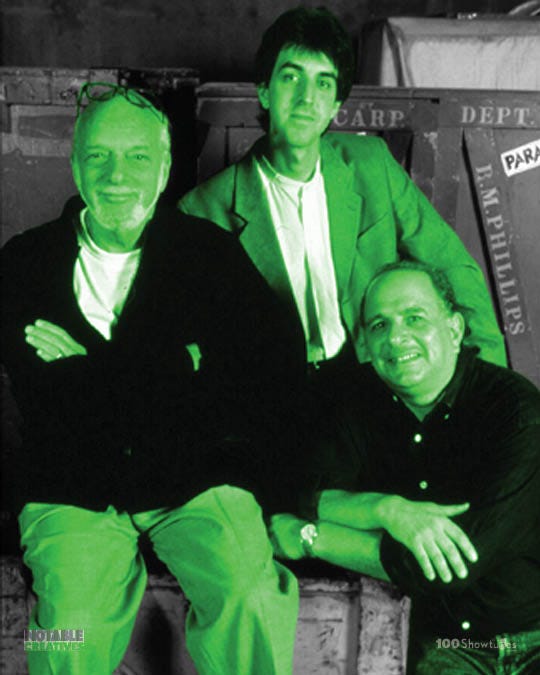
Felonies aside, Parade symbolized a passing of the torch to a new generation of theater makers. On one hand, you have the legendary Harold Prince, who conceived of and directed the piece. Playwright Alfred Uhry, best known for the quaint play and movie Driving Miss Daisy, wrote the book. These established creators joined forces with newcomer Jason Robert Brown. Brown had been building a reputation as a conductor and arranger, but his only stage composition was the off-Broadway song cycle Songs for a New World, which had a limited run in 1995. But its score, full of big sings and compelling stories, made an impression, especially on Harold Prince, whose daughter Daisy directed revue. In choosing Brown for Parade, Prince seemed to anoint Brown as the Next Sondheim—what else would you call a young composer-lyricist working with Harold Prince on a new musical that tackles challenging and unconventional themes? Brown’s score quickly became a favorite of theater fans who also devoured Songs…, and his folllow-up to Parade, the doomed-marriage two-hander The Last Five Years. These scores dominated cabaret acts and terrorized audition accompanists for years. Brown’s career since then has been an eclectic mix of “commercial” comedies, like 13 (Ariana Grande’s Broadway debut), and more serious fare, like The Bridges of Madison County. His latest work is about another famous murder in Georgia, a musical version of Midnight in the Garden of Good and Evil written with performance artist and playwright Taylor Mac. It announced a 2025 Broadway run that has yet to materialize, but it could potentially happen at any point when a suitable theater becomes available. Or never. At the very least they continue to pay for a URL and web-hosting.
Recommended Recording: “The Old Red Hills of Home,” Parade(1998 Original Broadway Cast)
Simply put, this recording is a cultural landmark, and, sadly, Broadway has seen few scores and recordings at this scale and grandeur since.
Alternate Performances
Parade has received 3 cast recordings (including the Original Broadway Cast).
2007 Original London Cast - Rob Ashford directed an entirely new production for Parade’s London premiere. The 2-disk cast recording captures a good amount of revision to the book and score. The production, at the small Donmar Warehouse, took more of a reduced “chamber approach” to the score, with reduced orchestrations. It’s a good supplement to the OBCR.
2023 Broadway Cast - By the time Parade saw its first Broadway revival in 2023, the show had amassed enough fans to make the production a sell-out hit. This production started as a Gala concert for New York City Center (like the current hit Ragtime revival). Jason Robert Brown was now the established, accomplished author watching a new crop of creators, like director Michael Arden, breathe new life into the show. Ben Platt defies the haters and sounds great, though Micaela Diamond’s Lucille is the big standout for me.
Is it Covered by The Rat Pack, Audra McDonald, or Glee?
Audra McDonald included a rendition of “You Don’t Know This Man”—in which Frank’s wife, Lucillle, defends her husband—on her first solo disk, Way Back to Paradise. The album, which was released a year before Parade opened, is comprised of songs by emerging writers, many of whom had three names: Jason Robert Brown, Michael John LaChiusa, Ricky Ian Gordon, Adam Guettel (grandson of Richard Rodgers), and Jenny Giering.
In the Wings
While you wait for song No. 37 to drop, you can explore an alarming amount of resources about the real life basis of Parade at leofrank.org. If you’re more interested in the other true crime associated with this musical, there’s Show Stopper: The Theatrical Life of Garth Darbinski, which is currently streaming for free on Tubi. If you don’t want to read about crimes at all, there’s this blog post by Jason Robert Brown, following the opening of the London production, that explains the some of the show’s revisions.
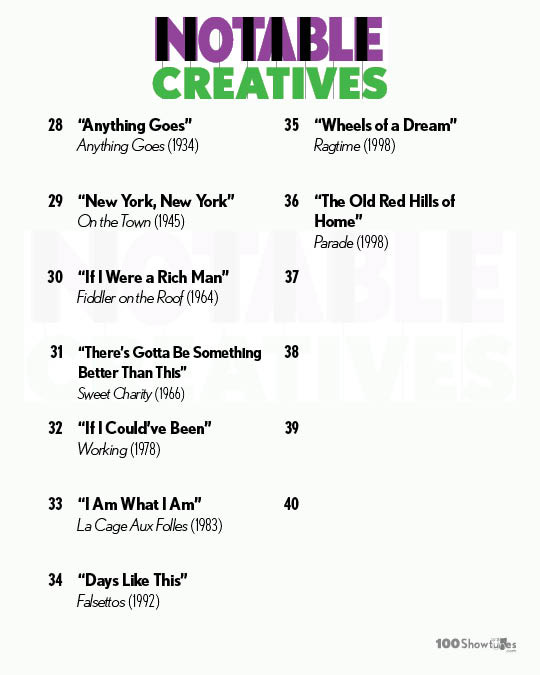
Catch up with all the songs to date!
Voiceover RSS feed for podcast apps: https://api.substack.com/feed/podcast/4189121.rss
The minute it was legal for him to produce musicals again, he launched—you guessed it—a historical musical drama exploring racial tensions in America (Paradise Square). But his bad behavior and inability to pay people in this production put him firmly on Actor’s Equity Association’s Do Not Work list.